10-03-2026
News
The call for applications has been closed. Thank you for participating.

The first year of VR Health Champions showed how important the right environment can be for developing healthcare technology. For the team behind MetaSkills, the programme provided access to partners, expertise and real clinical feedback. As Kuba Pędziwiatr, Chief Executive Officer and Co-founder of MetaSkills, puts it in one word: ecosystem.
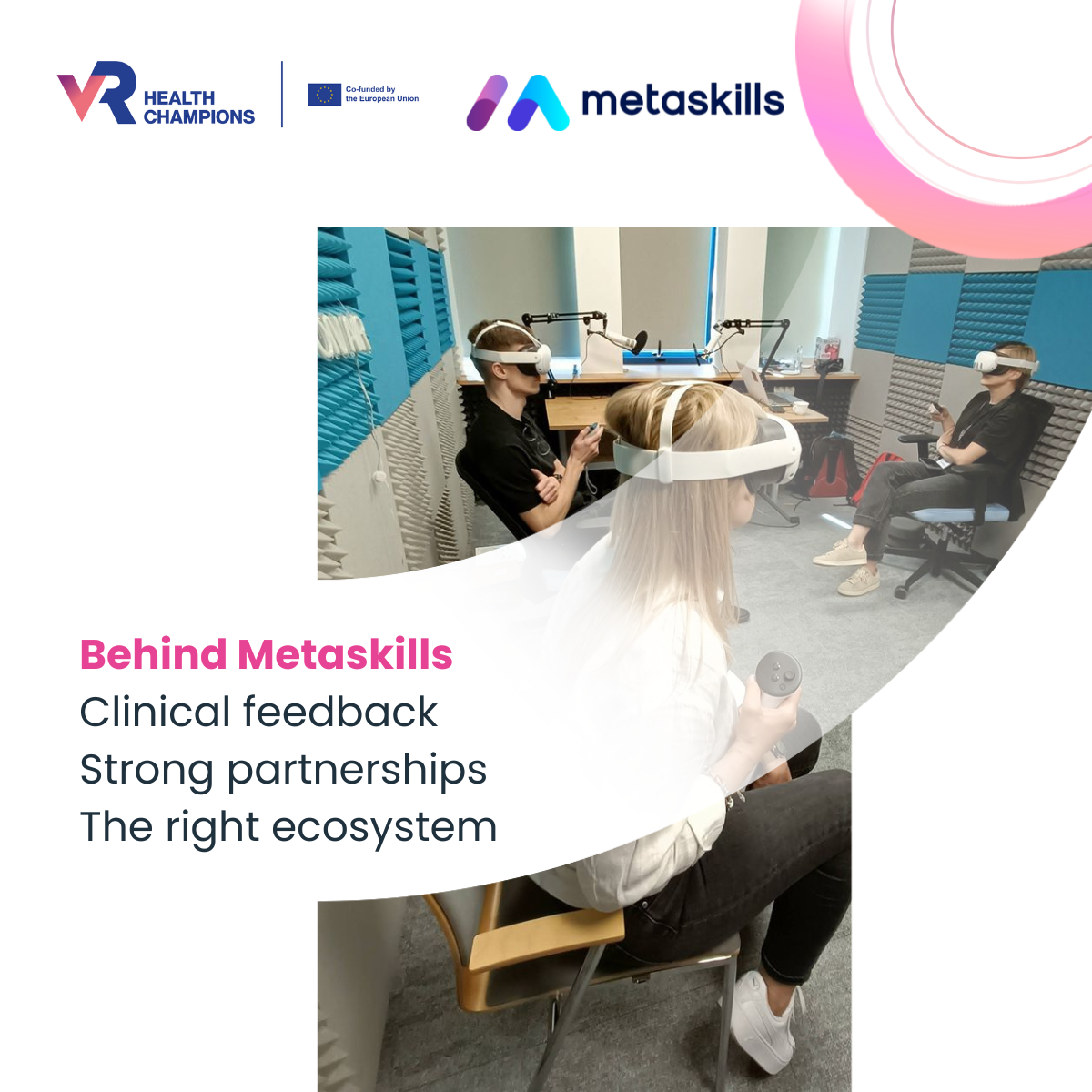
One of the most important milestones for MetaSkills was conducting the first structured tests with healthcare professionals. For the first time, the team gathered direct feedback from doctors and medical staff who could interact with the solution in realistic scenarios. These sessions provided concrete insights into usability, interaction design and the structure of training scenarios built within MetaSkills. The feedback quickly began shaping the product itself. It influenced how the team refines interaction flows, iterates scenarios and prioritises the next stages of development.
“Thanks to VR Health Champions, we were able to gather high-quality feedback directly from healthcare professionals for the first time. It fundamentally changed the way we develop MetaSkills.”
Developing a complex training environment like MetaSkills also brought technical challenges. As the platform evolves, ensuring scalability and system stability becomes increasingly demanding. The team had to continuously strengthen the system architecture while expanding functionality. At the same time, building advanced training scenarios required significant time and resources. Another layer of complexity came from components based on large language models, which need careful tuning to ensure reliability in a medical context.
Working through these challenges helped the MetaSkills team significantly strengthen both the technical foundation of the product and their development process. An important part of this journey was also the collaboration with MetaMedicsVR. Their experience helped the team understand how MetaSkills could operate effectively within the Spanish healthcare system.
The support covered linguistic localisation, medical terminology and the cultural expectations of healthcare professionals using training tools in Spain. These insights proved valuable not only for this specific market. They now serve as a reference point when planning future international expansion of MetaSkills.
“What we learned while working on the Spanish market now gives us much greater confidence when thinking about introducing MetaSkills in other healthcare systems.”
Looking ahead, the second year of VR Health Champions will focus on testing MetaSkills at a larger scale. The team plans to validate full training scenarios across multiple languages, platforms and healthcare roles. Access to diverse testing environments and expert feedback will remain essential. The aim is not only to confirm that MetaSkills works technically, but also that it delivers real clinical and educational value.
This leads back to the question of what makes VR Health Champions different.
Jakub’s answer is simple.
“If I had to describe VR Health Champions in one word, it would be: ecosystem. It is not just a support programme. It is a living ecosystem of knowledge, perspectives and real-world connections.”
For solutions such as MetaSkills, this kind of environment makes a tangible difference. It connects technology developers with clinicians, researchers and partners from different markets, creating conditions where innovation can be tested, challenged and improved much faster.