
The timeline on this website provides a clear overview of the full process from application to project implementation.
About the VR Health Champions Open Call 2026
VR Health Champions is a 3-year project aiming at breaking down market, clinical and regulatory barriers in XR healthcare across less developed regions of Central Eastern and Southern Europe, while fast-tracking the advancement of VR/AR applications.
It focuses on five flagship SMEs – Dotlumen, MEEVA, MedApp, Metaskills, and Virtuleap – that are leading this transformation. The project’s outcome is to upgrade their Technology Readiness Level (TRL) for VR/AR innovations from TRL 6 to TRL 9, ultimately creating pathways for future innovations in the sector.
To achieve this, VR Health Champions is now seeking SMEs active in areas such as clinical research, medical imaging, healthcare IT and AI, behavioral sciences, regulatory affairs, marketing and go-to-market strategies, market analysis, software testing, UX design, and computer vision, to be strategically matched with Flagship projects through cascade funding and to foster cross-sector knowledge exchange and technology transfer.
The VR Health Champions Open Call 2026 is your opportunity to have a real impact in the fast-growing healthcare XR sector. If you're a small and medium-sized enterprise (SME) and have expertise in XR healthcare developments, this is your chance to receive up to 60.000 € grant and contribute directly to the development of cutting-edge solutions alongside top-tier innovators.
The call for applications has been closed!
More InfoWhat you get?
-
Funding
Receive a lump sum grant up to a value of 60.000 € to address a specific challenge in the XR healthcare sector.
-
Collaboration with SMEs
Work closely with one of five cutting-edge flagship SMEs.
-
Ecosystem & Visibility
Get access to the VR Health Champions ecosystem, including the EIT Health network, XR4Europe and Medtronic
-
Value chain integration
Help build interregional innovation value chains through applied problem-solving.
Who should apply?
This programme is open to:
- SMEs as defined in EU Recommendation 2003/361/EC
- Applicants must be legally established in one of the following regions:
| Country | Region |
|---|---|
| Belgium | Brussels Capital region; Prov. Luxembourg (Less developed) |
| Bulgaria | Severozapaden (Less developed); Severen tsentralen (Less developed); Severoiztochen (Less developed); Yugoiztochen (Less developed); Yuzhen tsentralen (Less developed) |
| Croatia | Whole country (Less developed) |
| Czech Republic | Severozápad (Less developed); Severovýchod (Less developed); Střední Morava (Less developed); Moravskoslezsko (Less developed) |
| France (Outermost) | Guadeloupe; French Guiana; Martinique; Mayotte; Réunion; Saint Martin |
| Germany | Oberbayern region |
| Greece | Thessalia (Less developed); Ipeiros (Less developed); Dytiki Ellada (Less developed); Anatoliki Makedonia (Less developed); Thraki (Less developed); Voreio Aigaio (Less developed); Kriti (Less developed); Kentriki Makedonia (Less developed); Dytiki Makedonia (Less developed); Ionia Nisia (Less developed); Sterea Ellada (Less developed); Peloponnisos (Less developed) |
| Hungary | Budapest region; Pest (Less developed); Közép-Dunántúl (Less developed); Nyugat-Dunántúl (Less developed); Dél-Dunántúl (Less developed); Észak-Magyarország (Less developed); Észak-Alföld (Less developed); Dél-Alföld (Less developed) |
| Italy | Trento region; Molise (Less developed); Campania (Less developed); Puglia (Less developed); Basilicata (Less developed); Calabria (Less developed); Sicilia (Less developed); Sardegna (Less developed) |
| Latvia | Whole country (Less developed) |
| Lithuania | Vidurio ir vakarų Lietuvos regionas (Less developed) |
| Poland | Malopolska region; Lodzkie region; Małopolskie (Less developed); Śląskie (Less developed); Zachodniopomorskie (Less developed); Lubuskie (Less developed); Opolskie (Less developed); Kujawsko-pomorskie (Less developed); Warmińsko-mazurskie (Less developed); Pomorskie (Less developed); Łódzkie (Less developed); Świętokrzyskie (Less developed); Lubelskie (Less developed); Podkarpackie (Less developed); Podlaskie (Less developed); Mazowiecki regionalny (Less developed) |
| Portugal | Grande Lisboa; Centro region; Norte (Less developed); Centro (Less developed); Alentejo (Less developed); Azores (Outermost); Madeira (Outermost) |
| Romania | Nord-Est; Nord-Vest; Centru (Less developed); Sud-Est (Less developed); Sud–Muntenia (Less developed); Sud-Vest Oltenia (Less developed); Vest (Less developed) |
| Slovakia | Západné Slovensko (Less developed); Stredné Slovensko (Less developed); Východné Slovensko (Less developed) |
| Slovenia | Vzhodna Slovenija (Less developed) |
| Spain | Madrid; Castilla-La Mancha (Less developed); Extremadura (Less developed); Andalucía (Less developed); Ciudad Autónoma de Ceuta (Less developed); Ciudad Autónoma de Melilla (Less developed); Canary Islands (Outermost) |
What are the challenges?
Applicants must select one of the 14 challenge areas, each aligned with the innovation roadmap of a VR Health Champions Flagship SME.
Challenge 1: Virtuleap – Market Entry and Product Launch Strategy for Cogniclear VR

Virtuleap solution: Cogniclear VR – VR-based cognitive evaluation tool
Challenge objective: Define a go-to-market strategy for two EU private-sector markets.
Focus:
- Evidence-based country selection and competitive benchmarking
- Buyer archetype and stakeholder mapping
- Product positioning and pricing strategy
- Country-specific marketing & sales playbooks
Expected outcome: Market entry plan enabling early adoption and real-world data generation to support public-sector expansion.
Challenge 2: Virtuleap – GDPR, Cybersecurity, and Software Verification and Validation for Cogniclear VR
Virtuleap solution: Cogniclear VR – VR-based cognitive assessment tool.
Challenge objective: Ensure GDPR compliance, cybersecurity readiness, and software-as-a-medical-device (SaMD) verification and validation for regulatory alignment for Cogniclear VR.
Focus:
- Software verification & validation per IEC 62304:2006 / EN 82304-1:2017
- GDPR audit, RoPA, DPIA, privacy and consent documentation
- Cybersecurity assessment and ISO 81001 compliance
Expected outcome: All documentation prepared for integration into the MDR Technical Documentation, to support Medical Device certification and GDPR compliance.
Challenge 3: Virtuleap – Healthcare Professional Onboarding for VR Adoption
Virtuleap solution: Cogniclear VR – immersive cognitive assessment tool.
Challenge objective: Design structured onboarding for healthcare professionals.
Focus:
- VR literacy, clinical integration, and workflow alignment
- Onboarding framework and training modules
- Interactive prototype (wireframes + Figma demo)
Expected outcome: Mid-fidelity onboarding prototype that accelerates adoption and reduces integration barriers.
Challenge 4:MedApp – Pilot Stage Clinical Investigation & Formative Usability Evaluation (Kidney Biopsy AR Navigation)

MedApp solution: CarnaLife Holo MedNav – AR navigation for kidney biopsies.
Challenge objective: Conduct pilot clinical investigation and formative usability evaluation to generate early safety, performance, and workflow evidence.
Focus:
- GCP-compliant pilot with 5–10 procedures
- Usability testing with radiologists and surgeons
- CER input with workflow and safety findings
Expected outcome: Clinical Investigation and Usability Reports with data to support MDR compliance, CER documentation based on the pilot investigation
Challenge 5: MedApp – Segmentation (annotation) of a abdomen and chest CT images dataset.
MedApp solution: CarnaLife Holo MedNav – AR surgical navigation tool.
Challenge objective: Create segmentation (annotation) of anaotmical structures for abdominal and chest CT scans.
Focus:
- Segmentation of 100 CT datasets (abdomen + chest)
- Radiologist approval and QC
- MDR/AI Act-compliant dataset packaging
Expected outcome: Radiologist-validated segmentation dataset enabling AI training and regulatory submissions.
Challenge 6: Metaskills – Scenario Management Platform for VR Training Dialogues

Metaskills solution: AI-assisted VR training platform for healthcare soft skills.
Challenge objective: Develop a scalable platform for scenario creation and management.
Focus:
- Integration with Directus backend
- Scenario authoring wizard for non-technical users
- Role-based access, dashboards, and GDPR compliance
Expected outcome: Functional platform enabling easy creation, deployment, and monitoring of VR training dialogues.
Challenge 7: Metaskills – Digital Twin Model for Soft Skills
Metaskills solution: AI-assisted VR training for medical professionals.
Challenge objective: Define a structured digital twin model for soft skills.
Focus:
- Competency indicators and JSON data models
- Algorithms for updating profiles and recommendations
- Ethics & GDPR compliance framework
Expected outcome: Validated framework for representing and tracking soft skills, forming basis for adaptive VR training.
Challenge 8: Metaskills – On-Premise Language Models PoC
MetaSkills solution: AI-assisted VR training with secure, local deployment of Small and/or Large Language Models (SLM/LLM).
Challenge objective: Compare SLMs and LLMs in an on-premise environment, validating trade-offs in quality, scalability, and cost for EU market compliance.
Focus:
- Feasibility of SLMs for tasks like tone detection, empathy, and aggression analysis
- LLM benchmarking for nuanced dialogue, irony, and multi-language capability
- Model adaptation strategy (fine-tuning and/or retrieval) on proprietary datasets
- Secure PoC deployment with performance, compliance, and licensing evaluation
Expected outcome: Vendor-neutral proof-of-concept with comparative SLM vs. LLM results, hybrid deployment recommendations, and a reference architecture enabling MetaSkills to prepare an MVP and international rollout.
Challenge 9: Meeva – Feasibility Study for VR Skills Training in Neurodivergent Teens

Meeva solution: VR singleplayer app serious game, intended to strengthen cognitive, emotional and social skills in children and young adults with autism and/or ADHD.
Challenge objective: Evaluate market viability and adoption potential.
Focus:
- Market and stakeholder research in EU (Italy, Germany, Belgium, France)
- Pricing and business model validation
- Competitive and adoption barrier analysis
Expected outcome: Roadmap for market entry with validated business and pricing models tailored to caregivers and institutions.
Challenge 10: Meeva – Marketing & Communication Plan for VR Skills Training
Meeva solution: VR singleplayer app serious game, intended to strengthen cognitive, emotional and social skills in children and young adults with autism and/or ADHD.
Challenge objective: Create a marketing and communication strategy for adoption and visibility.
Focus:
- Buyer persona and customer journey mapping
- Funnel strategy, CRM, and automation tools
- Content and storytelling guidelines
- Website redesign recommendations
Expected outcome: Comprehensive marketing and communication plan enabling Meeva’s scaling and credibility in healthcare markets.
Challenge 11: Meeva – VR-Specific Technical & Documentation Framework
Meeva solution: VR singleplayer app serious game, intended to strengthen cognitive, emotional and social skills in children and young adults with autism and/or ADHD.
Challenge objective: Develop regulatory documentation framework for CE marking.
Focus:
- VR-specific CE technical file preparation (software validation, usability, safety)
- Risk-benefit and pre-clinical needs assessment and reports
- Templates and guidance for present and future regulatory submissions and AI act
Expected outcome: Technical documentation, clinical evaluation package and regulatory roadmap tailored to VR medical technologies.
Challenge 12: .lumen – Cybersecurity & Remote OTA in Wearables

DotLumen solution: Glasses for the Blind (LightKit) – Advanced assistive technology for visually impaired individuals
Challenge objective: Develop a secure OTA update mechanism for head-worn wearables.
Focus:
- Research of technologies for the main classes of HW required
- Implementing the cloud/server side and the edge side for the OTA
Expected outcome: Fully functional and secure OTA update system, tested and documented for .lumen wearables.
Challenge 13: .lumen – Indoor/Outdoor SLAM & VIO in Wearables
DotLumen solution: Glasses for the Blind (LightKit) – Advanced assistive technology for visually impaired individuals
Challenge objective: Enhance SLAM/VIO algorithms for indoor/outdoor transitions.
Focus:
- Identify “tough scenarios” (low light, elevators, GNSS-restricted)
- Benchmark current implementation vs. new solutions
- Develop improved algorithms for seamless indoor/outdoor operation
Expected outcome: Robust SLAM/VIO system handling complex navigation scenarios, fully documented and benchmarked.
Challenge 14: .lumen – Machine Learning Monocular Depth R&D
DotLumen solution: Glasses for the Blind (LightKit) – Advanced assistive technology for visually impaired individuals
Challenge objective: Create real-time monocular depth estimation models for wearable devices.
Focus:
- Research ML architectures for monocular depth
- Processing and gathering new datasets
- Training new architectures based on datasets
Expected outcome: Monocular depth ML models validated against state-of-the-art sensors, optimized for wearable deployment.
How to apply?
Applicants must select one of the 14 challenge areas, each aligned with the innovation roadmap of a VR Health Champions Flagship SME:
- Download and read the Open Call text and the Budget and Workplan template Excel
- Read the call text and select a challenge. Applicants can apply for one challenge.
-
Fill in the online application form and upload all the required annexes and documents by the 7 December 2025, 23:59 CET:
- Budget table and Workplan (please use the template available on the VR Health Champions Open Call website and upload the Excel version
- Company registration certificate (required only if no validated PIC number is available). Please upload a PDF file.
PLEASE NOTE FORMAL TERMS & CONDITIONS :
Only applications submitted before the deadline via the VR Health Champions website application platform will be considered.
Applicants (beneficiaries and affiliated entities) cannot participate in more than one proposal under the call for proposals.
VR Health Champions Open Call Webinar
22 October 2025, 15:00 CET
Missed webinar?
Don’t worry — we’ve got the slides and the recording for you.
Presentation
Download slides here

What is the timeline?
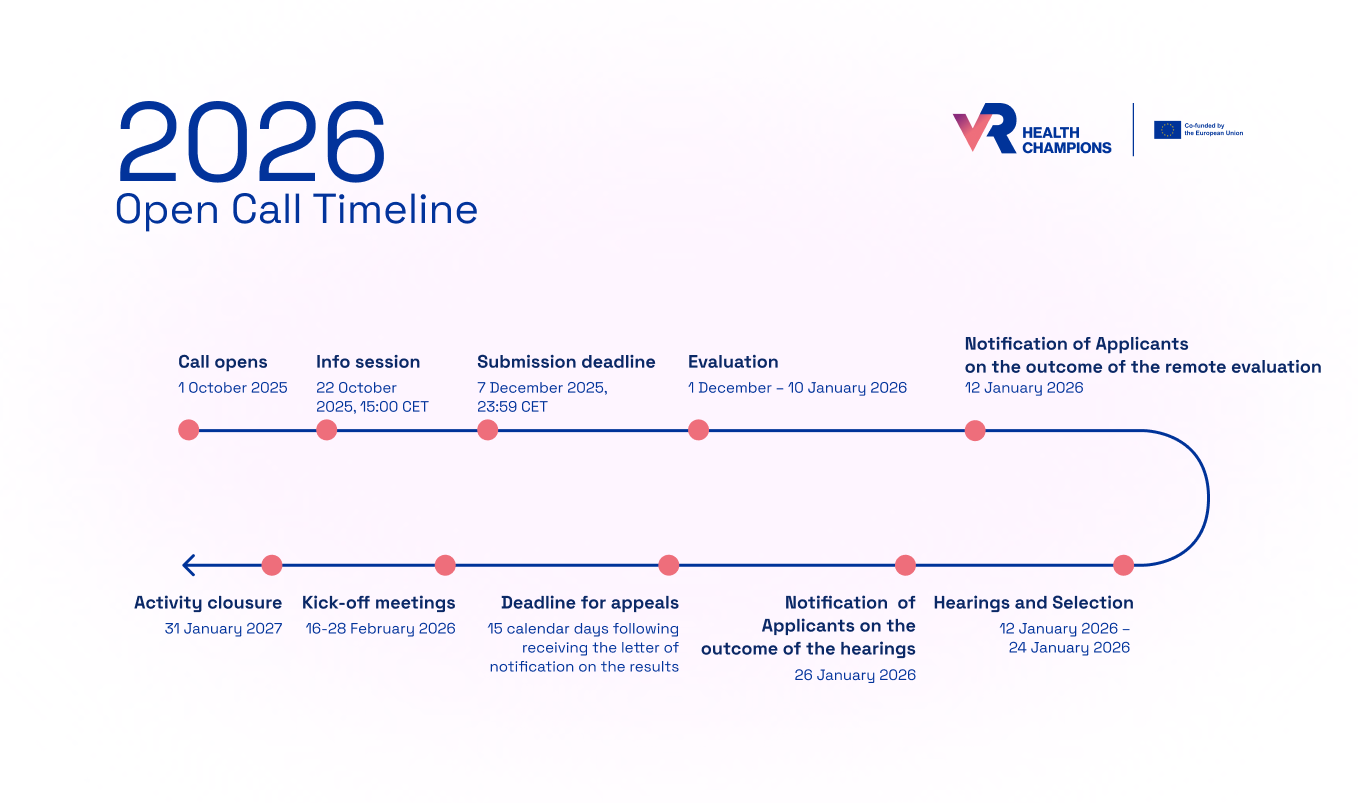
The call for applications has been closed.
Submissions closedFAQ
1. How much funding can I receive?
Each selected project can receive up to €60,000 as a lump sum. The The specific budget for each challenge is defined in Annex 1 – Challenge Descriptions of the Open Call text.
2. How many projects will be funded?
One application per challenge will be funded.
3. Can I apply to more than one challenge?
No. Each applicant may submit only one challenge proposal.
4. Is there support during the application process?
Yes – an info session will be held, and additional support is available via email at cascadecall@vrhealthchampions.eu . Full details can be found in the Open Call Document.
5. Could you please confirm the eligibility for organisations legally established in Ukraine to participate in this project?
According to the open call text, the eligible regions are the ones listed on the website and Ukraine is not among them
6. Our company is legally registered in a more developed region (e.g. Murcia, Spain), but we plan to carry out the main project activities—such as clinical validation—in a less developed EU region (e.g. Andalusia or Castilla-La Mancha). Would our SME still be eligible to apply?
According to the call text, applicants must be SMEs legally established in one of the following:
-
A region covered by the VR Health Champions consortium,
-
A less developed region within the European Union, or
-
An outermost region of the European Union, as recognised under Article 349 of the TFEU.
As the Region of Murcia (Spain) is not listed among the eligible regions of the call text, an SME registered in Murcia would not be eligible to apply directly under this call.
If collaboration between your Murcia-based company and partners in eligible regions is foreseen, this can be done through subcontracting or collaboration, in line with Section 4.3, which allows subcontracting up to 20% of the total project budget for external expertise or specialised services.
7. Our company is based in Barcelona (Spain). Are we eligible to apply for the VR Health Champions Open Call?
No. According to the call text, applicants must be SMEs legally established in one of the following:
-
A region covered by the VR Health Champions consortium,
-
A less developed region within the European Union, or
-
An outermost region of the European Union, as recognised under Article 349 of the TFEU
As the Region of Catalunya (Spain) is not listed among the eligible regions of the call text, an SME registered in Barcelona would not be eligible to apply directly under this call.
8. Is there a participation fee, and what happens after submitting the application? Could you also provide an overview of the expected timeline?
No, there is no participation or processing fee to apply for the VR Health Champions Open Call 2026.
After submitting your proposal through the online form on the project website, it will go through the evaluation process described in the call text:
-
Admissibility and Eligibility Check
-
Remote Evaluation
-
Hearings (Pitch Interviews)
-
Selection and Contracting
9. Our company is registered in a more developed region (e.g. Emilia-Romagna, Italy) but has an operational office in a less developed region (e.g. Campania). Are we eligible to apply for the VR Health Champions Open Call?
According to the open call text, Applicants must be legally established in one of the following:
-
- A region covered by the VR Health Champions consortium.
-
A less developed region within the European Union, as defined by the European Commission, where GDP per capita is below 75% of the EU average.
-
An outermost region of the European Union, as recognized under Article 349 of the Treaty on the Functioning of the European Union (TFEU).
Emilia-Romagna is not among the above-mentioned eligible regions. Therefore, a company legally established there is not eligible to apply.
10. Our company is registered in a more developed region (e.g. Lombardia, Italy) but has an operational site in a less developed region (e.g. Sicilia). The call text states that applicants must be “legally established” in an eligible region. Does this refer only to the registered office, or can it include other operational sites?
The term “legally established” refers specifically to the registered (legal) office of the SME as recognised in official company registration documents.
Operational or branch offices located in eligible (less developed) regions do not qualify an SME for eligibility if the legal seat is registered in a non-eligible region. Therefore, only SMEs legally registered in one of the eligible regions listed in Section 4.1.2 of the call text can apply.
11. Does Challenge 6 ask to create VR scenarios? Or just a web platform for create and manage scenarios using pre existing assets or modules?
Challenge 6 does not ask you to create VR scenarios. It focuses on a web platform to create, adapt, license, and report on scenarios using our pre-existing assets/modules and back-end services.
– In scope: Web app for scenario authoring/adaptation, user/license management, reporting dashboards, integration with existing Metaskills systems & VR application, GDPR/fairness safeguards.
– Authoring tool: Our scenario authoring engine is being developed by Metaskills; your platform will integrate with it (level of integration defined during discovery).
12. Question for Virtuleap Go To Market challenge: Does the Cogniclear app contain language? I.e. will it need to be translated to the local language of the EU countries it is looking to enter?
Yes, Cogniclear features a robot that speaks throughout the experience, with all dialogue supported by subtitles. The app is currently localised in Portuguese, Spanish, Hindi, English, Polish, and Italian. Localising to additional languages is relatively straightforward, and we are testing Cogniclear in multiple countries to ensure cultural neutrality, so language should not be a limiting factor when the cascade funding partner is evaluating the market to enter with Cogniclear VR.
13. Could you confirm if the restriction on participating in more than one proposal applies across all challenges, or can applicants submit separate proposals for different challenges?
According to section 4.1.2 (Eligibility of Applicants), “Applicants (beneficiaries and affiliated entities) cannot participate in more than one proposal under the call for proposals.”
This restriction applies across all challenges, not per challenge. Each SME may only submit one proposal total for this call.
14. You mentioned that the call should help projects to advance from TRL 6 to TRL 9. Is this advancement related to the project of the 5 partner SMEs? Or to a product/technology owned by the applicant?
The TRL advancement described in Section 2.2 of the Open Call text refers to the five flagship SMEs’ innovations, not to the applicants’ own technologies.
Applicants are expected to contribute specific expertise to help these flagship SMEs close their value chain gaps and move their innovations closer to market readiness. The applicants themselves do not have to demonstrate TRL progression of their own product.
15. How long does the company need to exist to apply?
There is no minimum period of existence stated in the call.
Applicants must simply qualify as an SME under the European Commission definition (EU Recommendation 2003/361/EC) and be legally established in an eligible region. Even newly founded SMEs can apply if they meet these criteria and provide a valid company registration certificate (or PIC number).
16. Could a Berlin-based, Hamburg-based or Halle-based company in Germany apply?
No.
Only SMEs legally established in the eligible regions listed in Table 4 may apply.
For Germany, the only eligible region is Oberbayern.
Berlin, Hamburg, and Halle are not eligible regions for this call.
17. Are universities, RTOs or consortium of universities considered eligible as applicants?
Eligibility (Section 4.1.2) is strictly limited to SMEs as defined by the European Commission.
18. It’s unclear to me which region in France is eligible for the call.
For France, only the outermost regions listed in Table 4 are eligible:
Guadeloupe, French Guiana, Martinique, Mayotte, Réunion, and Saint Martin.
Mainland regions (e.g., Île-de-France, Auvergne-Rhône-Alpes, etc.) are not eligible.
19. Could you please clarify what the fields “Registration Seat”and “Registration Number” in the application form refer to?
A company’s registration seat is its official legal address, which determines its jurisdiction and the laws it must follow. A company registration number is a unique, official identifier assigned to a business upon its incorporation.
20. What happens if the total project management costs and other expenses exceed the approved financial budget?
- During proposal preparation phase: proposal budget exceeding the maximum of the challenge budget specified in Annex 1 – Challenge Descriptions may be submitted, however this will be taken into account when assessing the Resource allocation efficiency and Approach feasibility within time and budget constraints, Best Value for Money – Justification of budget, cost breakdown, and alignment with market standards during the evaluation process.
- During reporting phase: if the actual delivery costs for the Participants exceed the approved grant amount, reimbursement can only be made up to the level of the approved grant. Any additional costs incurred beyond the approved financial budget will remain the sole responsibility of the Participants.
21. Could you please describe the mechanism of the 7% flat fee?
E. Indirect cost will be reimbursed at the flat-rate of 7% of the eligible direct costs (A. Direct Personnel Costs, C.1 Travel and subsistence, C. 3 Other goods, works and services) meaning that the challenge budget specified in Annex 1 – Challenge Descriptions shall be calculated as this 7% is included where applicable. Budget template of the call automatically calculates this amount.
Example: if the challenge budget specified in Annex 1 – Challenge Descriptions is EUR 10,000 and the Applicant plans to utilize the total budget available on A. Direct Personnel Costs then the direct amount of A. Direct Personnel Costs shall be EUR 9,345.79 and the 7% E. Indirect cost shall be EUR 654.21.
22. Is the project fully funded or does it require co-financing?
Open call text Section 3.5: The financial support to SMEs will be calculated as a maximum of 100% of eligible costs, up to €60.000, but the applicants may request a lower grant rate/grant amount.
23. Does the 60k need to cover the whole budget or can it be a part of a larger budget. If so, are there any restrictions to co-financing?
Participants may utilize co-funding for the delivery of their project, however, double funding (i.e., same investment financed under different EU instruments) must be avoided.
24. If the estimated cost is 30000€, would a project budget of less/more than 30000€ still be considered?
1. During proposal preparation phase: proposal budget exceeding the maximum of the challenge budget specified in Annex 1 – Challenge Descriptions may be submitted, however this will be taken into account when assessing the efficiency of resource allocation during the evaluation process.
2. During reporting phase: if the actual delivery costs for the Participants exceed the approved grant amount, reimbursement can only be made up to the level of the approved grant. Any additional costs incurred beyond the approved financial budget will remain the sole responsibility of the Participants.
25. Will the final price quote be part of the evaluation? E.g. does that matter is the final price is 17K EUR or 19K EUR?
The submitted budget will be taken into account when assessing the Resource allocation efficiency and Approach feasibility within time and budget constraints, Best Value for Money – Justification of budget, cost breakdown, and alignment with market standards during the evaluation process.
26. We are an SME registered in Câmpina, Prahova County, Romania. Are we eligible, and does our profile fit within the call’s scope?
Yes. Organisations based in Prahova County (Sud–Muntenia region) are eligible, as the region is listed among Romania’s less developed regions covered by the call.
27. We would like to apply with a company for one of the challenges in the Open Call. We are part of a cluster of companies and could potentially participate with two SMEs in different challenges, which are all controlled by the same company. Would these proposals be eligible or should we participate in only one challenge with a single company?
According to the call conditions (Section 4.1.2 – Eligibility of Applicants), applicants and their affiliated entities may only participate in one proposal under this call. This means that even if the SMEs are part of the same cluster or group and controlled by the same parent company, only one legal entity from that group can submit a proposal.
Therefore, you would need to select one of your SMEs to apply for one challenge only under the current Open Call.
28. MedApp challenge 4: Will participating SMEs receive access to the CarnaLife Holo MedNav system, including the AR hardware necessary for the pilot procedures, or is this expected to be procured independently?
The CarnaLife Holo MedNav will be provided by MedApp S.A. for the time of the pilot procedures with appropriate training. We can also assist during the first treatment.
29. MedApp challenge 4: How are clinical sites selected for the pilot study? Is MedApp planning to collaborate directly with the clinical centers, or is the applicant expected to organize and secure the study site?
Criteria for selection of clinical sites can be established by the applicant in collaboration with MedApp S.A. The applicant is expected to organize and secure the study site and collaborate directly with the clinical centers.
30. MedApp challenge 4: Besides financial support, will selected SMEs receive training, technical integration guidance, regulatory documentation support, or direct collaboration with MedApp’s clinical team?
The selected SME will receive appropriate training and will be able to collaborate directly with MedApp’s clinical team.
31. Challenge #6: Metaskills: Is Challenge #6 (“Metaskills”) looking for a technical partner to co-develop the content or to handle only the technical aspects of the platform?
The challenge seeks a technical collaborator, not a content co-creator. The goal is to integrate new functionalities or modules into the existing Metaskills platform, focusing on technical implementation (e.g. Digital Twin, on-prem SLL) rather than content design or pedagogical development.
32. Challenge #6: Metaskills: What are the intellectual property (IP) rights related to the results developed under this challenge?
In line with the VR Health Champions project framework, the intellectual property generated within the challenge will remain with the challenge owner. Any IP resulting from the collaboration must be transferred to the challenge owner.
33. Hello, we are an SME established in Türkiye. Can we apply for the VR HEALTH call?
No. SMEs established in Türkiye are not eligible to apply for the VR Health Champions Open Call.
According to the call’s eligibility criteria, applicants must be legally established in one of the following locations:
-
A region covered by the VR Health Champions consortium,
-
A less developed region within the European Union, or
-
An outermost region of the European Union.
This full list of eligible regions is provided in Section 4.1.2 – Eligibility of Applicants and also on the website, which includes only EU Member State regions. Türkiye is not listed among the eligible regions.
34. Our SME operates from an eligible region, but our legal/registered office is located elsewhere. Are we eligible to apply?
Eligibility is determined exclusively by the location of the SME’s legal (registered) office as stated in its official company registration documents. An operational site, branch office, or activity location in an eligible region does not qualify an SME if its legal seat is registered in a non-eligible region. Only SMEs legally established—meaning legally registered—in one of the eligible regions listed in Section 4.1.2 of the call text are eligible to apply.
35. What should the initial application look like at the preliminary stage? Do we apply via the website?
Applications must be submitted electronically via the application form on the VR Health Champions website.
Proposals must be complete and include all parts and required attachments and supporting documents, including:
• Budget table and work plan
• Company registration certificate (required only if a validated PIC number is not available)
The link to the application platform and budget and work plan template, is available on the website: https://vrhealthchampions.eu/get-involved/
36. What is a PIC?
A PIC number a Participant Identification Code, a unique 9-digit number assigned by the European Commission to organizations that participate in EU funding programs. More info is available here: https://ec.europa.eu/info/funding-tenders/opportunities/portal/screen/how-to-participate/participant-register
37. What documents are required at the application stage?
At submission, only the following documents are mandatory:
-
Budget table and Work Plan
-
Proof of legal establishment (only if you do not have a validated PIC number)
38. What counts as acceptable proof of legal establishment?
Your registration certificate must clearly indicate the place of legal establishment, as this is needed to verify geographic eligibility.
Acceptable documents include:
-
For sole proprietors: an official extract from the relevant national registry confirming the legally registered address.
-
For companies: an official company register extract issued by the competent national authority showing the registered seat.
If the registration certificate does not explicitly state the legal address, you may provide any other official document issued by a competent authority that confirms the legal seat.
39. Will additional SME verification documents be requested later?
Yes. In line with the call text, the VR Health Champions consortium may request additional documents during the evaluation, contracting, or post-selection phases.
These may include:
-
Balance sheet or financial statements
-
Documentation confirming the number of employees
Such documents are requested only if needed and only from applicants advancing to later stages.
40. Can an applicant re-apply in the second round if they were not selected in the first round?
Yes. Applicants who were not selected in the first round are fully eligible to re-apply in the second round.
41.Challenge #7 Metaskills: What VR hardware does the challenge-setting company use? Does the equipment support eye-tracking (i.e., can it measure eye movements)?
We do use Meta Quest 3 and Quest Pro internally (Quest Pro has eye-tracking).
However, it’s worth highlighting that for the purposes of this specific cascade call the hardware itself is not central.
The challenge is not about building VR scenes or heavy VR mechanics — it’s mainly about:
-
modelling behavioural patterns,
-
building the Digital Twin for soft-skills assessment,
-
working on interpretation, analytics, and feedback layers.
In practice, most submissions won’t need VR headsets at all.
If someone wants to use their own equipment or ours, that’s possible — but it is absolutely not a requirement for this call.
42. Challenge #7 Metaskills: Where should the proposed VR scenarios be executed? At the SME’s location, the challenge provider’s facilities, or either?
Since this challenge is not hardware-driven, execution can happen fully at the SME’s location.
If at any point someone needs to test something with our setup, they can arrange that, but it’s optional and doesn’t need to be budgeted as equipment cost.
43. Challenge #7 Metaskills: Can applicants rely on equipment provided by the challenge-setting company, and how should this be reflected in the budget?
Yes — if someone wants to use their own equipment or ours, that’s possible.
But again, it is not required, and because the challenge is not hardware-centric, it does not need to be included as an equipment cost.
44. Challenge #7 Metaskills: Budget and timeline: The challenge instructions say 60,000 EUR for 12 months. However, during a fireside chat, Metaskills’ CEO mentioned 30,000 EUR for 6 months. Is this flexible? Do I need to modify my application?
The budget is exactly as mentioned during the fireside chat: up to 60,000 EUR.
Since we have 3 different calls in this round, we have different budgets per each.
The budget limits per call are mentioned under each call description — they vary from 30,000 to 55,000 EUR.
So yes, the differences reflect the specific budget of the given challenge, not flexibility or negotiation.
45. Where can I find the Work Plan template for the VR Health Champions Open Call 2026?
The Work Plan is included as the third sheet (“Workplan”) of the mandatory Budget Table Excel file:
26092025_VRHC_Open_Call_2026_LS-budget_template.xlsx
You can download the file from the VR Health Champions website:
https://vrhealthchampions.eu/get-involved/ → Download call text and documents for submission.
The Excel file contains three sheets:
-
Instructions
-
Budget Table
-
Workplan
Applicants must complete all three sheets and upload the file during submission.
46. Challenge #6 Metaskills: Do we need to include travel costs in the budget? We did not see this mandatory requirement in the open call guidelines. Will there be a face-to-face meeting required for the project? We have foreseen meetings online with the consortium and the partners, and we do all the tasks online, but if a face-to-face meeting is needed, we would like to know how to include it in the project budget.
There are no mandatory in-person meetings, and applicants do not need to include any travel costs in the budget.
If anyone wants to meet in person, it can always be arranged optionally, but it is not required at any stage of the project. All coordination and implementation activities can be fully executed online.